

INTRODUCTION
Where We Stand
Maren can feel the salt-air dampness in her lungs as she walks the harbour road in Reykjavik. It is May 2025, and four hundred policymakers, youth leaders, and researchers have gathered at Harpa Conference Hall for the Wellbeing Economy Forum.
Inside, the Icelandic delegation is presenting their vision of an economy measured not by what it produces, but by what it protects.
Outside, the North Atlantic laps against basalt, indifferent to the language of GDP.
Maren had studied economics for five years before she heard the term “post-growth.” Now it is the only phrase she can speak without flinching.
In September 2025, the Potsdam Institute published the Planetary Health Check.
The results were stark: seven of nine planetary boundaries have now been breached, including, for the first time, ocean acidification.
CO₂ stands at 424 parts per million.
Radiative forcing has doubled the safe threshold.
The Earth’s carbon sinks are saturating.
The systems that sustained ten thousand years of human civilization are faltering. The science says: this is a diagnosis.
If growth can no longer be the organizing principle of human economies, what comes next? And who gets to decide?
These are the two critical uncertainties that will shape the decade ahead. First: how fast will the transition away from growth-dependent systems actually happen? Will it be gradual and incremental, or rapid and systemic? Second: who will steer it? Will it be centralized, state-led governance, or will it emerge from distributed, community-driven networks? The answers to these two questions produce radically different worlds. In this issue, we visit four of them.
PORTFOLIO OF FUTURES
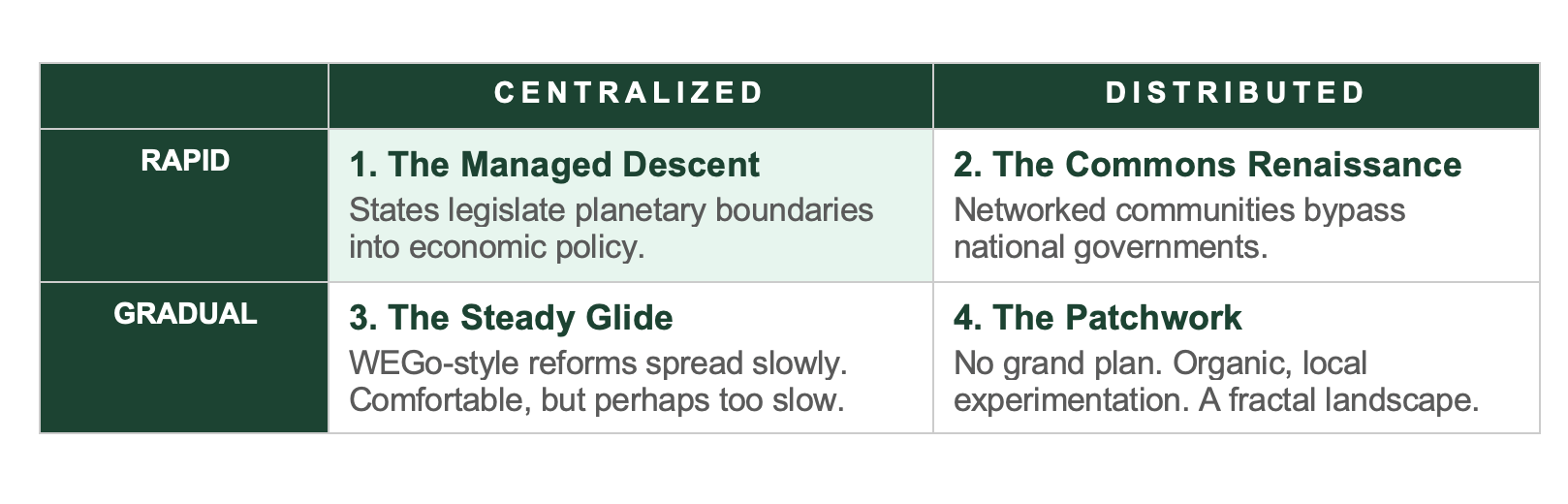
Four Worlds for 2036
Two questions define the decade ahead. How fast will the transition happen (gradual or rapid)? And who will lead it (centralized states or distributed communities)? The intersection of these axes produces four plausible worlds.
World 1: The Managed Descent
THE SETTING
It is 2036. A coalition of European governments, led by a second-generation WEGo bloc, has ratified the Planetary Boundaries Accord. National resource caps are law. GDP is still measured but no longer targeted; the official metric is the Composite Wellbeing Index (CWI), which tracks health outcomes, social connection, ecological restoration, and time sovereignty.
The 32-hour workweek is standard across the EU. Carbon budgets are allocated to households via digital accounts. Corporate sustainability reporting, once watered down by the Omnibus reforms of 2026, has been tightened again under the review clauses.
The economy is smaller in material throughput but richer in services, care work, and ecological repair. Critics call it managed decline. Advocates call it the first honest economy in two centuries.
A DAY IN THE LIFE
Sanna, Helsinki, 2036.
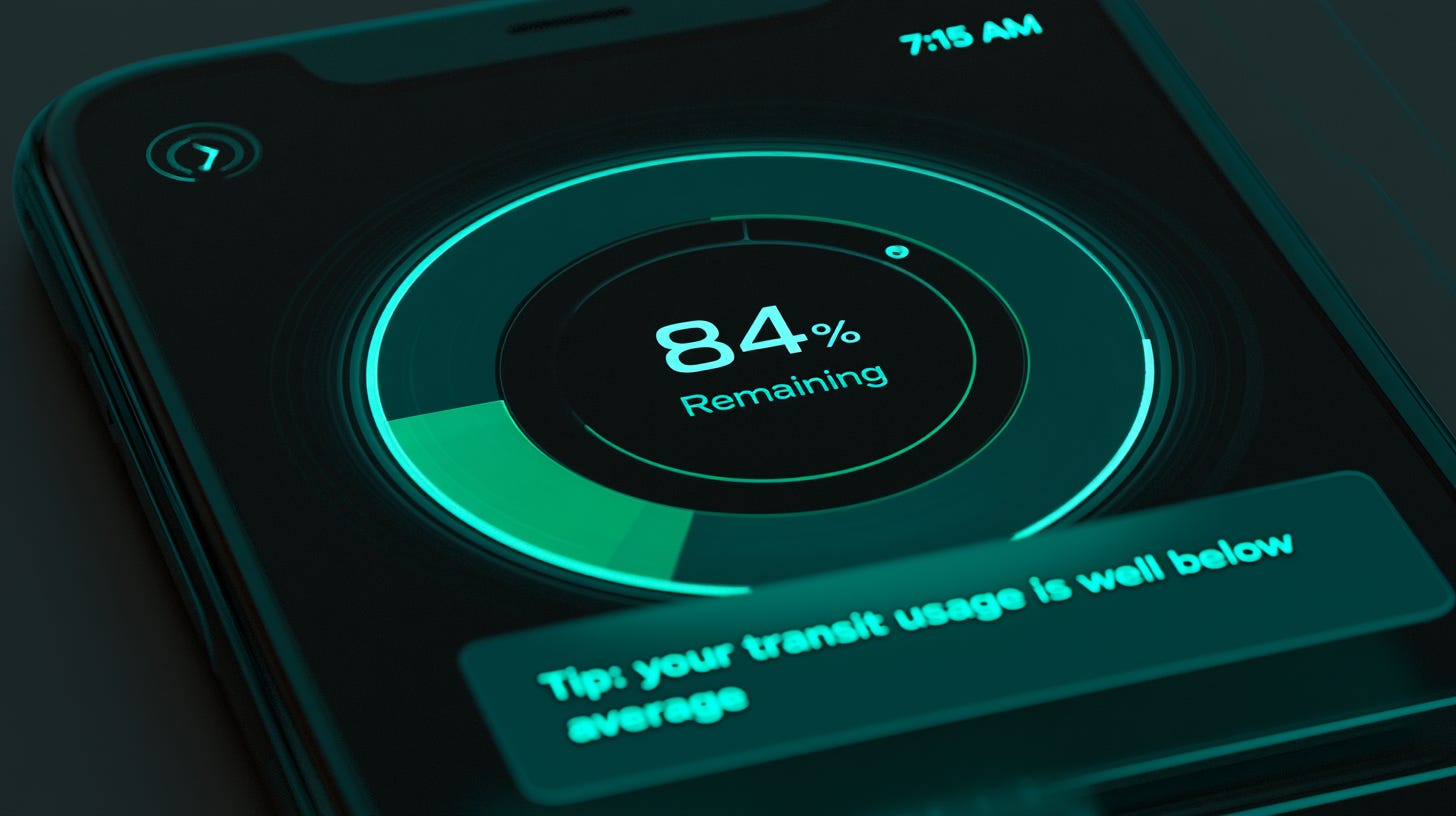
The notification from her Boundary Budget app arrives at 7:15 AM. “Monthly resource allowance: 84% remaining. Tip: your transit usage is well below average.”
Sanna smiles. She cycles to the municipal care cooperative where she works three days a week as a physiotherapist.
On Thursdays, she teaches movement classes at the neighbourhood commons, logged as “civic contribution” on her CWI profile, which supplements her Universal Basic Services access.
She has never earned more than €2,400 a month. She has also never been healthier, less anxious, or more certain that her daughter will inherit a coastline that isn’t retreating.
At lunch, she scans the canteen’s seasonal menu, all sourced within 200 kilometres.
The prices are adjusted by ecological footprint. She picks the root vegetable stew. It is the cheapest thing on the menu, and it is delicious.

Prototype: Boundary Budget App
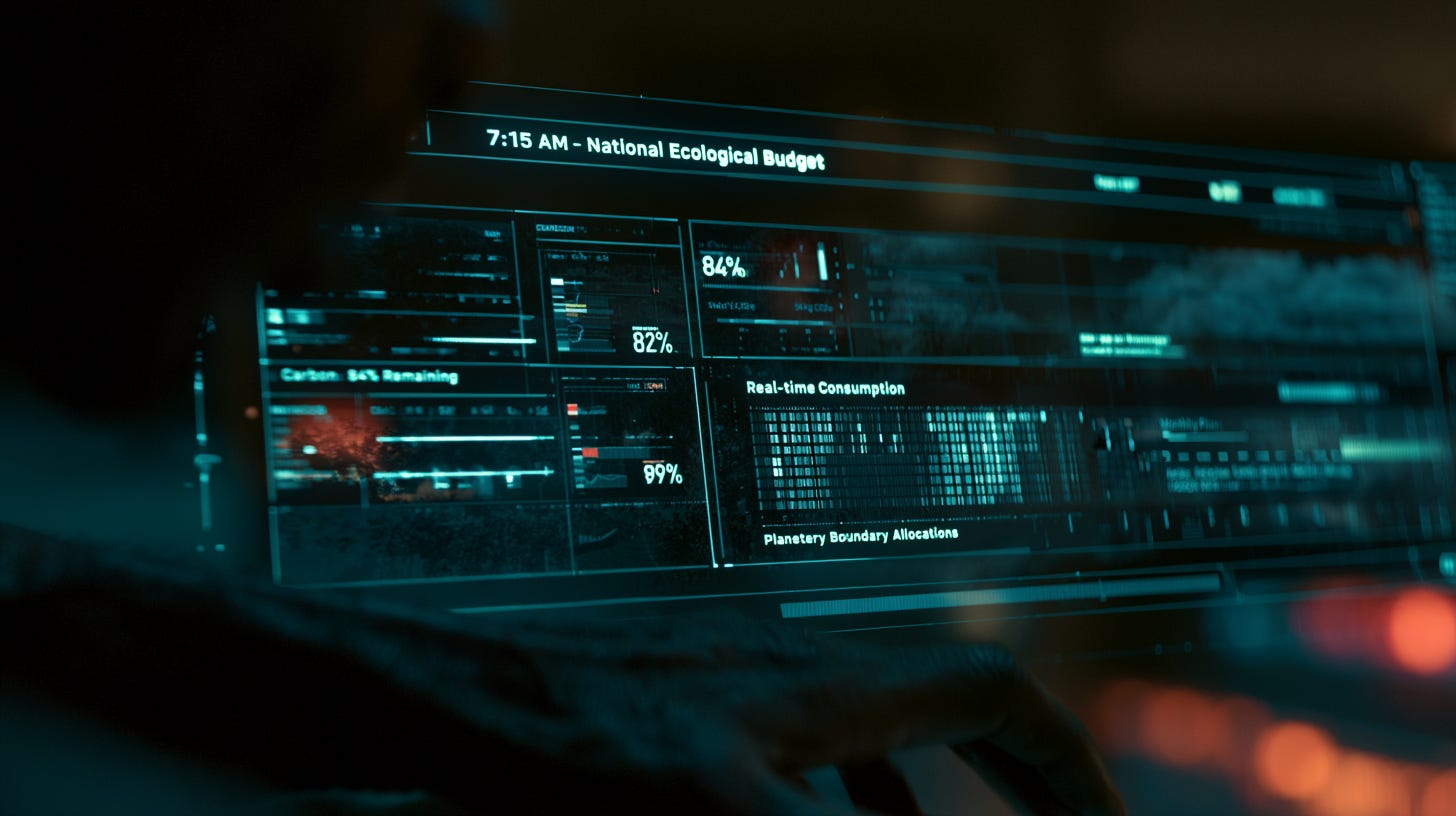
A government-issued personal resource accounting platform. Citizens receive a monthly ecological budget (carbon, water, materials) and can track their consumption against planetary boundary allocations in real-time.
“Monthly resource allowance: 84% remaining. Your transit usage is well below average. Consider sharing unused credits with your neighbourhood pool.”
World 2: The Commons Renaissance
THE SETTING
National governments proved too slow, too captured, too beholden to debt-servicing logics. So the transition happened anyway, from below.
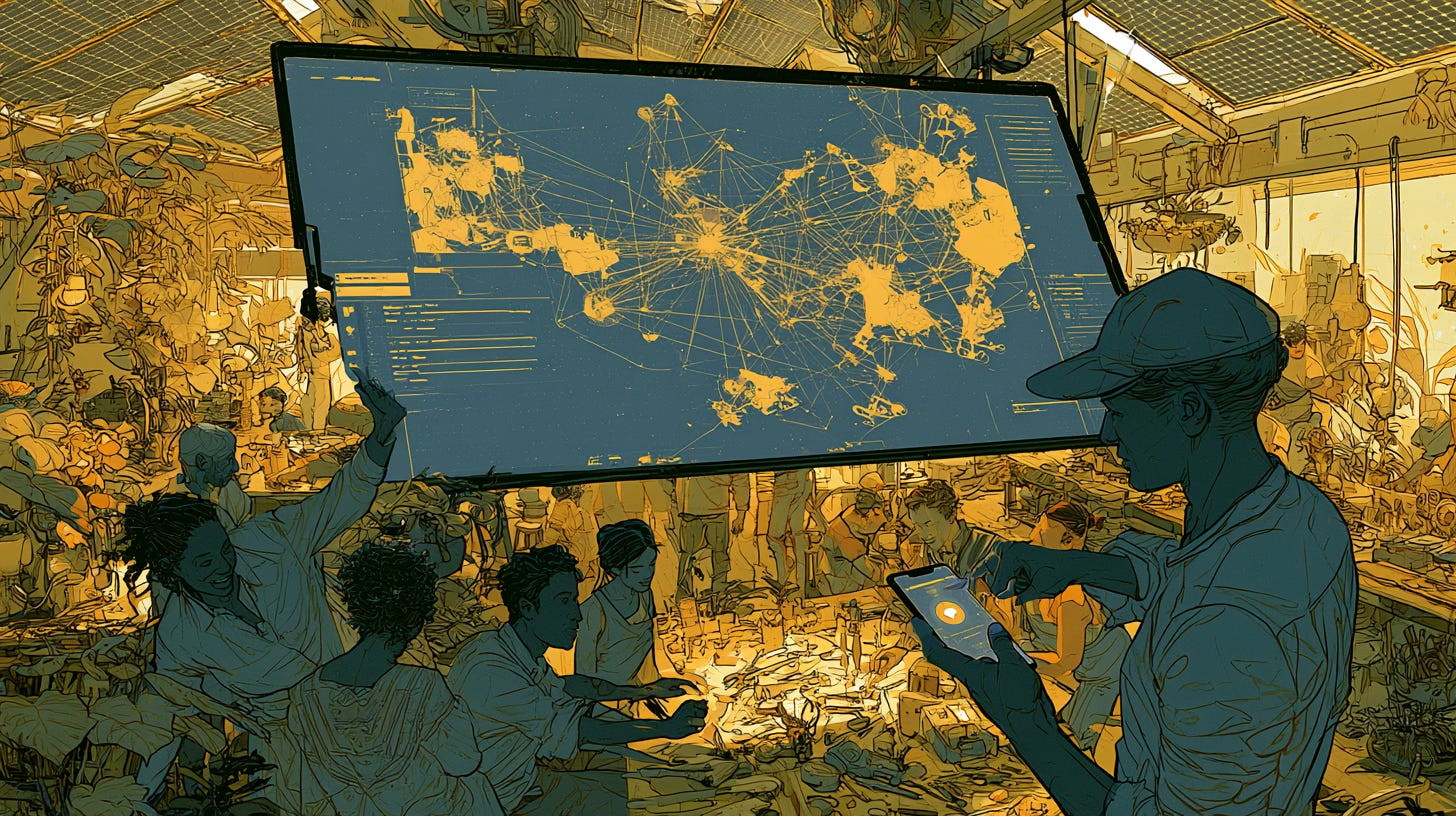
By 2036, a dense network of community land trusts, cooperative platforms, local currencies, and mutual aid federations has created a parallel economy operating alongside the formal one.
Open-source hardware designs are shared globally.
Repair cafes, tool libraries, and community kitchens reduce material consumption without reducing quality of life.
Energy cooperatives generate and distribute renewable power locally.
Some national governments resist.
Others tentatively support these networks, recognizing them as the only institutions delivering measurable improvements in both wellbeing and ecological outcomes.
A DAY IN THE LIFE
Tomás, Porto, 2036. Tomás wakes in a housing cooperative that was once a derelict textile factory. His rent is pegged to 18% of his income, decided by the co-op’s monthly assembly.
This morning, he checks the FabCommons platform on his tablet, where his neighbourhood’s tool library, vehicle-share fleet, and community workshop are listed alongside available volunteer shifts.
He has signed up for a three-hour slot repairing small appliances, a skill he learned from a retired electrician in the same building. Payment comes in Douro Credits, the local complementary currency accepted at participating shops, the farmers’ market, and the community energy cooperative.
After lunch, Tomás works remotely for a Lisbon-based consultancy, his formal-economy job, four hours a day, four days a week.
His grandmother, who remembers the austerity years, tells him this life looks fragile. He tells her it is the only arrangement that has ever felt sturdy.
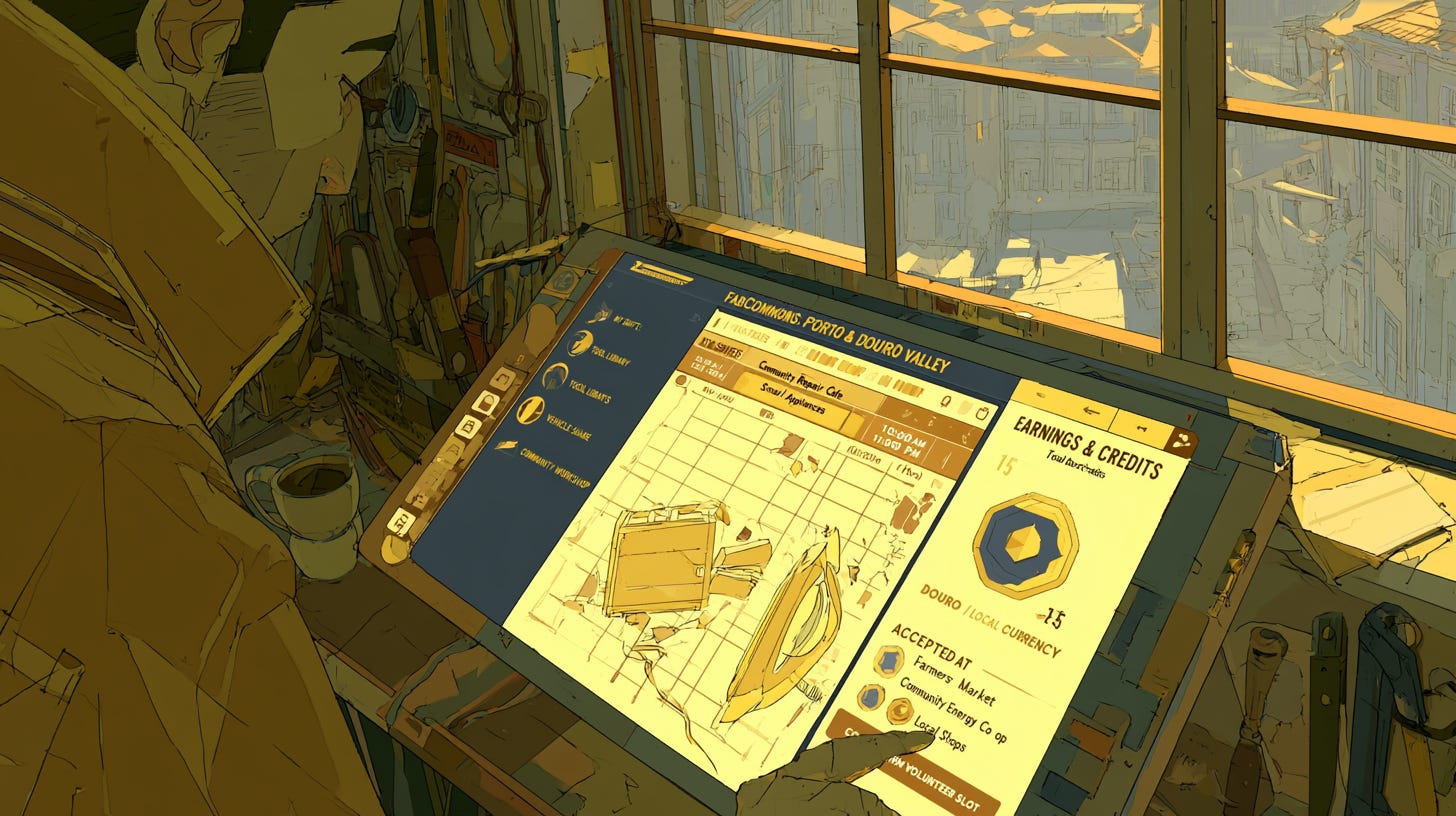

Prototype: FabCommons Platform
An open-source digital platform connecting neighbourhood tool libraries, vehicle-share fleets, community workshops, and repair services into a single federated network. Transactions occur in local complementary currencies.
“Available now in Cedofeita: DeWalt drill (tool library, 3 Douro Credits/day). Repair slot: small appliances, Saturday 10-13h, 2 slots remaining.”
World 3: The Steady Glide
THE SETTING
This is the world of incremental reform. By 2036, most OECD nations have adopted some form of Beyond-GDP dashboard.
Wellbeing budgets are standard in Scandinavia and spreading to parts of Asia-Pacific. The four-day workweek is law in three countries and common practice in twelve more.
Sustainability reporting is robust but voluntary for companies below 1,000 employees.
Ecological indicators are improving in some areas (air quality, ozone) but deteriorating in others (biodiversity, ocean acidification).
The transition is real, but it is too slow for the planetary timeline. Carbon sinks continue to weaken. The fundamental tension of this world is that it proves post-growth policy works, while simultaneously demonstrating that gradualism may be insufficient.
A DAY IN THE LIFE
Aisling, Dublin, 2036. Aisling’s Monday begins with a notification from the national Wellbeing Dashboard, a public app that replaced the old economic bulletins.
Social connection: up 3% this quarter.
Biodiversity index: down 1.2%.
She sighs.
As a civil servant in the Department of Wellbeing and Ecological Transition (formed in 2029), she spends her four-day weeks drafting policy that she believes in but that arrives at the speed of committee.
Today, she is reviewing the annual Sufficient Living Report, a document that benchmarks household consumption against planetary boundaries.
Her own household scores well: they share a car with two neighbours, their energy comes from a community wind cooperative, and their diet is largely plant-based. But she knows the aggregate numbers.
The country is doing better. The planet is not doing well enough. She closes her laptop at 4 PM and walks to the park with her daughter, who is learning, in primary school, to read a Doughnut diagram the way Aisling once learned to read a balance sheet.
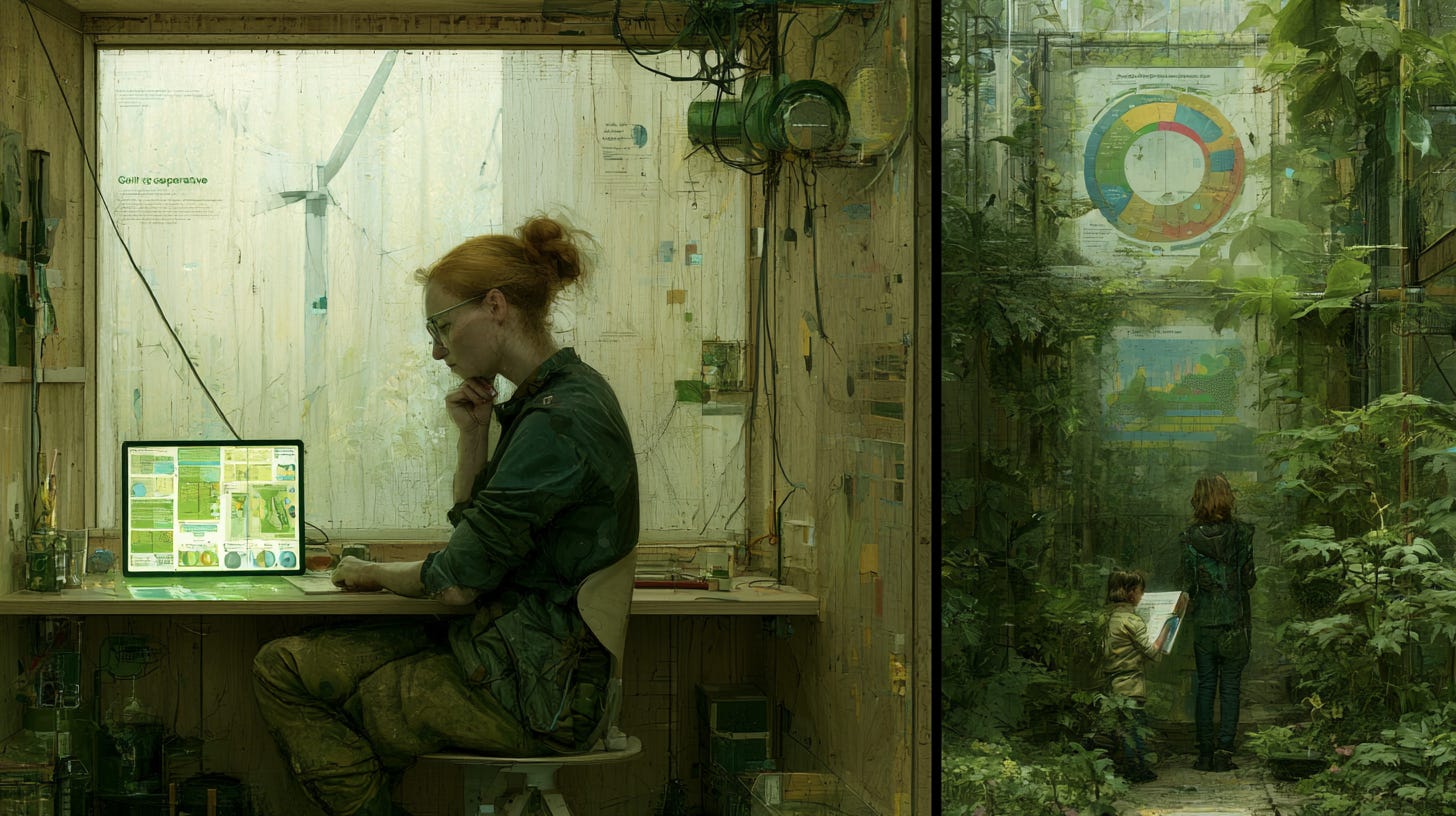

Prototype: National Wellbeing Dashboard
A public-facing digital platform that replaces the traditional economic bulletin with a composite view of social, ecological, and economic indicators. Updated quarterly. Taught in schools. Referenced in parliamentary debate.
“Ireland Wellbeing Dashboard Q3 2036: Social connection +3%. Biodiversity index -1.2%. Time sovereignty +5%. Air quality +8%. Overall CWI trend: improving (slow).”
World 4: The Patchwork
THE SETTING
No grand plan emerged. No global accord. No commons revolution.
Instead, the decade produced an uneven mosaic of local experiments, some brilliant, some failed, and a vast number of places where nothing much changed at all. Certain cities and bioregions have become exemplars: the Amsterdam Doughnut Zone, the Welsh Valleys Sufficiency Corridor, the Catalan Commons Belt.
These are places where reduced consumption, cooperative housing, local food systems, and ecological repair have produced measurably better lives. But they exist alongside regions locked into extractive growth, rising inequality, and accelerating ecological decline.
The question this world asks is whether islands of post-growth thriving can survive inside an ocean that has not yet decided to change.
A DAY IN THE LIFE
Abe Gersma/Rotterdam, 2036. Abe lives what his friends call a “split life.” Six months in Chengdu, where his parents run a small manufacturing firm still embedded in the growth economy, and six months in Rotterdam, where he co-manages a bioregional food hub operating under Doughnut principles.
In Chengdu, his mornings are filled with supply chain logistics, factory emissions reports, and pressure to hit quarterly targets. In Rotterdam, his mornings begin with soil tests in the rooftop polytunnel and a check on the cooperative’s seasonal distribution plan. He does not think one life is better than the other.
He thinks they are both real, and that most people he knows live somewhere between them, trying to hold both truths at once.
Today, in Rotterdam, he is preparing a shipment of organic produce for a neighbourhood subscription service. The box includes a card: “Grown within 80km. Fed 4 people. Used 12 litres of water. Choose your world.”
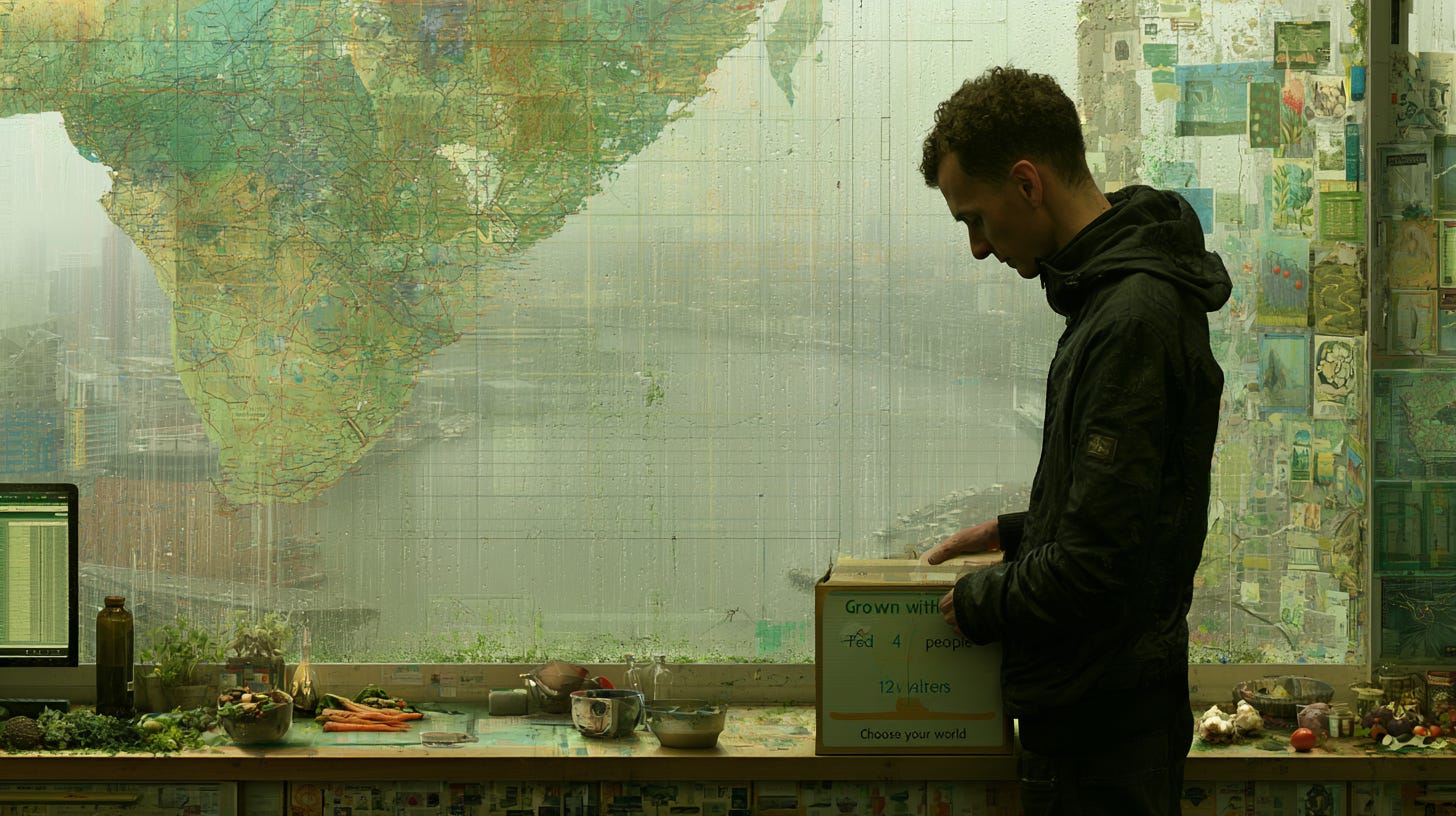

Prototype: Bioregional Food Hub
A cooperative distribution centre connecting local farms to neighbourhood subscription services within an 80km radius. Each delivery includes a transparency card showing water, carbon, and labour metrics.
“Box #4,271, Week 38. Grown within 80km. Fed 4 people. Used 12 litres of water. Carbon: 0.8 kg CO₂e. Choose your world.”
CONCLUSION
Blueprints for a Protopian Future
What these four worlds reveal, taken together, is not a debate between growth and its absence. It is something older and more intimate: the question of what constitutes a good life within the constraints of a finite planet.
Sanna in Helsinki, Tomás in Porto, Aisling in Dublin, and Abe between Chengdu and Rotterdam are all, in their own way, trying to answer the same question. They want meaningful work without exhaustion. Food that doesn’t cost the ocean. A home that doesn’t require a lifetime of debt. Time to be with the people they love. These are not radical demands. They are ancient, inner ones, expressed in new conditions.
The strategic pathway is clear, even if the political one is not.
In the near term (0-2 years): societies should invest in wellbeing measurement infrastructure, prototype personal resource tracking, and expand four-day workweek trials beyond self-selected companies into mandated public sector pilots.
In the mid term (3-5 years): integrate ecological indicators into budget cycles, scale cooperative platforms with interoperability standards, and introduce Doughnut Literacy into national curricula.
In the long term (6-10 years): legislate resource caps, establish international certification for post-growth exemplar zones, and build the financial architecture that rewards ecological repair over material expansion.
The ozone layer is healing. That fact alone tells us that planetary boundary breaches are not destiny. They are the result of choices, and choices can be made differently. The window remains open. The only question that matters now is one I cannot answer for you:
Which of these worlds would you choose to build? And what would you be willing to change about your own life to make it real?
THE SIGNAL DECK
Research & Analysis: PESTLE Trend Map
Thirty-six findings mapped across six domains.
HC = High Confidence, WS = Weak Signal
Political
HC WEGo partnership now includes Scotland, Iceland, New Zealand, Wales and Finland, with Canada actively participating. (Source: WEAll / WEGo) (Wellbeing Economy Alliance)
HC EU Omnibus I package was adopted on 24 February 2026, narrowing CSRD scope to companies with more than 1,000 employees and more than €450m net annual turnover. (Sources: EU Council; White & Case, 2026) (Consilium)
HC US Guaranteed Income Pilot Program Act of 2025 was introduced in the 119th Congress on 24 October 2025. (Sources: GovInfo / Congress.gov; Rep. Watson Coleman, 2025) (GovInfo)
WS Approximately 61% of Europeans favour post-growth approaches, while 68% of surveyed G20 citizens say the economy should prioritise the health and wellbeing of people and nature over profit and increasing wealth. (Sources: Futures / Degrowth Network; Earth4All/Ipsos, 2024) (explore.degrowth.network)
WS Wales moved furthest of the WEGo nations in a post-growth direction, including sufficiency-oriented policies such as limits on road building. (Source: Nature Humanities & Social Sciences Communications, 2024) (Nature)
WS Amsterdam was the first city to work with Doughnut Economics and develop a City Portrait in 2020; Copenhagen and Brussels later adopted related doughnut applications, while Glasgow is better supported as a circular-economy policy case rather than a confirmed doughnut adopter. (Sources: DEAL; Time; EU Covenant of Mayors; Friant et al., 2023; Savini, 2024) (Doughnut Economics Action Lab)
Economic
HC Four-day week evidence includes a 2025 Nature Human Behaviour study covering 141 organisations and 2,896 workers across six countries; wider Schor/4 Day Week Global work covers 245 companies and 8,700 workers, and reporting on the 2025 study says about 90% of participating companies kept the shorter week. (Sources: Nature Human Behaviour / PubMed; Phys.org; Investopedia; SAP, 2025) (PubMed)
WS Catalonia’s UBI pilot was designed for 5,000 people, with €800/month for adults and €300/month for minors, but later Catalan reporting says the budget was not approved and the plan was not tested in practice. (Sources: Ivàlua; Catalan News; ARA, 2025; Borgen Project, 2025) (ivalua.cat)
HC WEGo nations remain structurally dependent on GDP growth and have been characterised as following a “weak post-growth” approach. (Source: Frontiers in Sustainability, 2022) (Frontiers)
WS The Post-Growth Deal / REAL project is testing post-growth policy, politics, provisioning systems and modelling approaches for wellbeing within planetary boundaries. (Sources: REAL; CORDIS; Spash, 2026) (realpostgrowth.eu)
WS The Lancet Planetary Health 2025 review identifies advances in post-growth research, including ecological macroeconomic models and policy approaches for wellbeing within planetary boundaries. (Source: The Lancet Planetary Health, 2025) (The Lancet)
WS OpenResearch’s unconditional cash experiment gave 1,000 low-income individuals $1,000/month for three years; recipients worked 1.3 fewer hours per week and were 2 percentage points less likely to be employed on average. (Sources: OpenResearch; NBER, 2024) (OpenResearch)
Social
HC UK four-day week trial results reported 39% lower stress and 71% reduced burnout at the end of the trial; the larger 2025 six-country study also found reduced burnout and improved job satisfaction, mental health and physical health. (Sources: Autonomy; Scientific American, 2023 and 2025) (The Autonomy Institute)
HC In 2024, 22% of respondents to APA’s Work in America survey said their employer offered a four-day workweek, up from 14% in 2022. (Source: APA Monitor, 2025) (APA)
HC The Guaranteed Income Pilot Program Act cites survey findings that 85% of Gen Z could not cover a $1,000 emergency expense. (Source: H.R.5830 / TrackBill text mirror) (PolicyEngage)
WS Degrowth and post-growth thinking is expanding into urban planning, housing, spatial planning and urban activism. (Sources: Savini, 2023/2024; Urban Studies; AESOP; Postgrowth Cities) (IDEAS/RePEc)
WS Wales’ basic income pilot for care-experienced young people provided £1,600/month pre-tax for up to 24 months; official evaluation is ongoing, with early qualitative findings focused on young people’s experiences, autonomy, wellbeing and financial decision-making. (Sources: Welsh Government; CASCADE; The MJ, 2025/2026) (GOV.WALES)
WS A systematic review in Ecological Economics maps post-growth and degrowth research across a large literature base and identifies major focal topics in the field. (Sources: Ecological Economics / VTT, 2026) (IDEAS/RePEc)
Technological
HC McKinsey estimates that, with generative AI, around 30% of US hours worked today could be automated by 2030, affecting a wider set of work involving expertise, interaction and creativity; McKinsey also notes that current AI technologies could theoretically automate more than half of current US work hours, while stressing this is not a direct job-loss forecast. (Sources: McKinsey, 2023 and 2025) (McKinsey & Company)
HC AI productivity gains could make shorter workweeks more feasible; Juliet Schor’s four-day-week research spans hundreds of companies, and recent reporting links AI-enabled productivity to renewed shorter-week interest. (Sources: CNBC/Schor via LinkedIn; SAP; Business Insider, 2025) (LinkedIn)
HC Renewable energy costs continue to fall: IRENA reported that 91% of new renewable projects commissioned in 2024 were cheaper than fossil-fuel alternatives, while Paris-compatible absolute decoupling remains contested in high-income countries. (Sources: Reuters/IRENA, 2025; The Lancet Planetary Health, 2023) (Reuters)
WS TNFD is pushing investors and companies to assess, report and act on nature-related dependencies, impacts, risks and opportunities, including biodiversity, ecosystem and water-related risks. (Sources: TNFD; UNDP; NBIM, 2025) (tnfd.global)
WS The Planetary Health Check provides an annual quantitative assessment of Earth-system risks against the planetary-boundaries framework. (Sources: Planetary Health Check; Stockholm Resilience Centre / PIK, 2025) (Planetary Health Check)
WS Digital platforms are enabling cooperative and commons-based economic models at scale, including platform cooperatives that offer an alternative model to conventional digital platforms. (Source: OECD, 2023) (OECD)
Legal
HC EU CSRD: companies in scope must report according to European Sustainability Reporting Standards; revised ESRS drafts published in 2026 aim to reduce mandatory datapoints by more than 60% and total datapoints by more than 70%. (Sources: European Commission; EFRAG, 2026) (Finance)
HC EU CSDDD/CS3D scope was narrowed under the 2026 Omnibus changes to companies with more than 5,000 employees and more than €1.5bn net turnover, while due-diligence obligations still concern human-rights and environmental impacts. (Sources: EU Council; CSDDD tracker / Normative, 2026) (Consilium
HC Senator Bernie Sanders introduced a 32-hour workweek bill in March 2024; the bill aimed to reduce the standard workweek from 40 to 32 hours with no loss in pay. (Sources: Sen. Sanders; Rep. Takano; AP, 2024) (Senator Bernie Sanders)
WS Sustainability-linked loans reportedly make up more than 25% of new corporate loans in Europe, though I found this mainly as a CSE-Net claim citing BNP Paribas rather than the original BNP Paribas report. (Source: CSE-Net, 2026) (Center for Sustainbability & Excellence)
WS EU Omnibus review clauses mean CSRD/CSDDD scope could be revisited, including possible future extension of scope. (Sources: EU Council; ISS Corporate, 2026) (Consilium)
WS Rights of Nature legislation and case law continue to spread: Ecuador constitutionalised rights of nature in 2008; Colombia’s Constitutional Court recognised the Atrato River as a rights-bearing subject in 2016; and India’s Uttarakhand High Court recognised the Ganga and Yamuna as legal entities in 2017, although India’s Supreme Court later stayed/overturned that ruling. (Sources: Heinrich Böll Foundation; Eco Jurisprudence; Oxford Journal of Environmental Law; Yale / Guardian) (Heinrich-Böll-Stiftung)
Environmental
HC The 2025 Planetary Health Check reports that 7 of 9 planetary boundaries have been breached, and all seven breached boundaries show worsening trends. (Sources: Stockholm Resilience Centre; Planetary Health Check / PIK, 2025) (stockholmresilience.org)
HC [source/date corrected] Planetary Health Check 2025 reported atmospheric CO₂ at 423 ppm against a 350 ppm boundary, with anthropogenic radiative forcing of about +2.97 W/m²; Population Connection later noted CO₂ at 424.69 ppm on 8 October 2025. (Sources: Planetary Health Check / PIK; Arcadia Foundation; Population Connection, 2025) (Planetary Health Check)
HC Even with strong environmental policy measures, 2050 projections still show pressure on several planetary boundaries; current trends and policies worsen all assessed boundaries except ozone depletion. (Source: Nature, 2025) (Nature)
WS Natural carbon sinks on land and in the ocean are saturating or turning into sources, while early warning signs of tipping behaviour are emerging. (Source: Earth Commission, 2025) (Earth Commission)
WS The extinction rate remains above 100 E/MSY, far beyond the planetary boundary of 10 E/MSY. (Sources: Science Advances, 2023; Planetary Health Check, 2025) (Science)
WS Ozone depletion and aerosol loading remain the only two boundaries in the safe zone; ozone recovery and falling aerosol pollution are cited as evidence that coordinated action can change planetary trends. (Sources: Stockholm Resilience Centre / PIK; Earth Commission; WMO, 2025) (stockholmresilience.org)
Causal Links
The most critical causal chain runs: Planetary boundary breaches create political legitimacy for non-growth frameworks, which enable wellbeing economy adoption, which in turn creates institutional capacity for resource caps and reduced work-time.
This chain is accelerated by AI-driven productivity gains (which make reduced hours economically viable) and decelerated by structural growth dependency of welfare states (which makes governments reluctant to abandon GDP targeting).
The EU’s CSRD/CSDDD framework creates a parallel feedback loop: sustainability reporting makes ecological impacts visible to markets, which shifts capital allocation, which creates commercial incentives for lower-throughput business models.
The Omnibus weakening of 2026 slowed this loop, but the review clauses keep it alive.